Hezbollah leader vows complete liberation of southern Lebanon, praises Iraq for expelling US
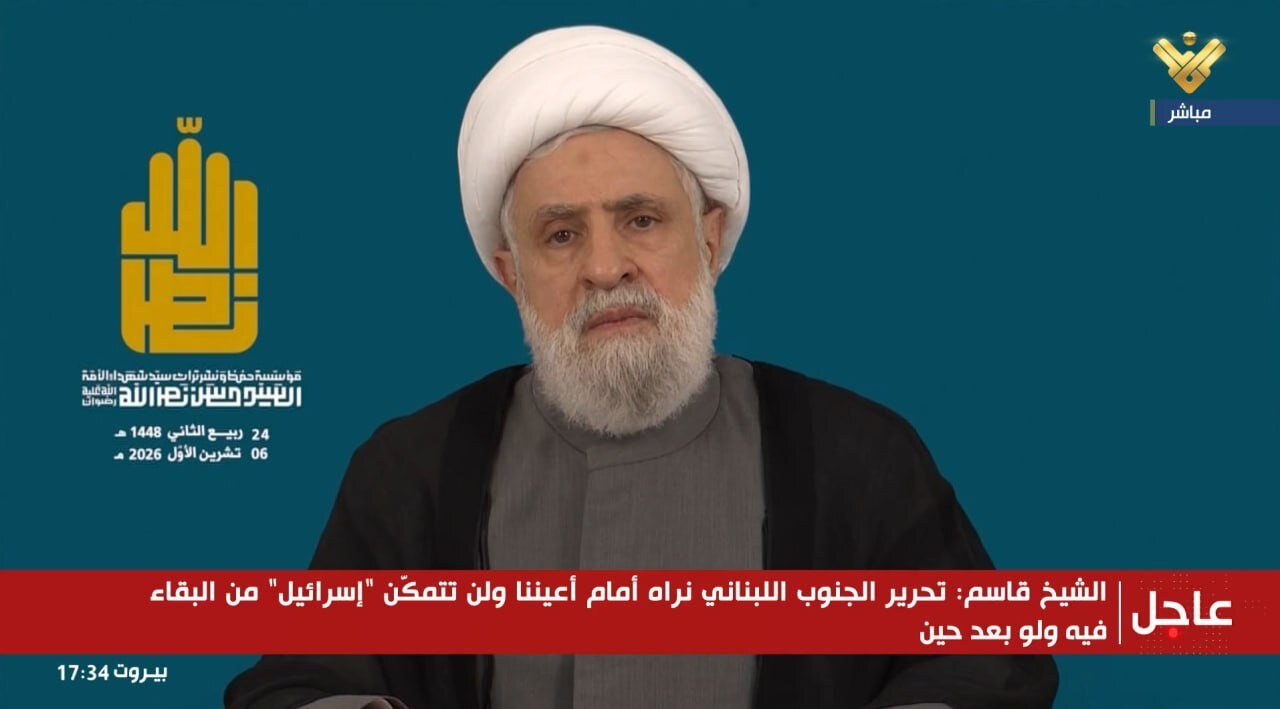
TEHRAN — Hezbollah Secretary General Sheikh Naim Qassem declared Tuesday that the liberation of southern Lebanon is within sight, reiterating that Israeli forces will fail to maintain their illegal occupation regardless of time.
Speaking during a televised address in Beirut, the Resistance leader made the complete withdrawal of Israeli troops the non-negotiable prerequisite for any regional resolution, firmly dismissing American-backed demands for unilateral disarmament while enemy troops remain on Lebanese soil.
Institutionalizing a revolutionary legacy
The address was delivered at a ceremony marking the official launch of the Foundation for the Preservation and Dissemination of the Heritage of Sayyed Hassan Nasrallah.
Approved by Hezbollah’s Shura Council and managed directly under the oversight of the Secretary General, the institution will archive, publish, and study three decades of historical speeches, intellectual works, and operational records left by the martyred leader.
Sayyed Nasrallah, who assumed leadership in 1992 following the Israeli assassination of Sayyed Abbas al-Musawi, spent 31 years building an enduring infrastructure of armed resistance.
Sheikh Qassem emphasized that this vast collection of documents and oral history will serve as a permanent reference for scholars, universities, and future generations fighting for liberation, dignity, and sovereignty.
Six pillars of Resistance
Sheikh Qassem outlined six fundamental pillars defining the movement’s intellectual and operational framework built under Sayyed Nasrallah.
First is the steadfast commitment to authentic Muhammadi Islam as a comprehensive guide for human dignity and social governance.
Second is the cultivation of jihadist culture rooted in the sacrifice of Imam Hussein (AS) at Karbala and the steadfastness of Lady Zainab (SA), turning Imam Ruhollah Khomeini’s declaration that “everything we have is from Muharram [and Ashura]” into daily practice.
Third is the principle of Wilayah, extending the tradition of divinely ordained authority embodied by the Twelve Imams [of Twelver Shiism] to the contemporary leadership of Imam Khomeini and the martyred Grand Ayatollah Seyyed Ali Khamenei.
Fourth is the active spiritual tie to Imam Mahdi (may Allah hasten his noble reappearance), instilling confidence in the ultimate triumph of global justice over oppression.
Fifth is the pursuit of Islamic and national unity, enshrined in the defense equation uniting the army, the people, and the Resistance against foreign occupiers.
Sixth is active military defense. Sheikh Qassem paid tribute to pioneer Resistance leaders, including Sheikh Ragheb Harb, Sayyed Abbas al-Musawi, Imam Musa al-Sadr, and Iranian General Qassem Soleimani, whose strategic support bolstered regional military capabilities against Western-backed aggression.
Rejection of foreign dictates and Israeli occupation
Turning to field developments, Sheikh Qassem delivered an assessment of ongoing hostilities across the Lebanese front.
He stressed that two years of intense Israeli bombardment and ground incursions backed fully by Washington have failed to crush the Resistance, break its popular base, or allow the Israeli military to establish permanent settlements on Lebanese soil.
“Do not ask us what we will do,” Sheikh Qassem stated, addressing external political pressures aimed at enforcing unilateral concessions. “We can only be a Resistance as long as this aggression exists.”
The Hezbollah leader also rejected U.S.-sponsored diplomatic formulas that demand the group disarm while Israeli forces remain entrenched in southern Lebanon.
He insisted that the responsibility lies entirely with the occupying power to cease its violations and withdraw in defeat.
“The solution begins with the enemy’s withdrawal under humiliating conditions,” he added, identifying the joint Israeli-American aggression as the primary source of regional destruction.
Regional solidarity and internal unity
Evaluating broader regional dynamics, Sheikh Qassem commended the Iraqi people, their religious authority, and the Popular Mobilization Forces for driving American occupation forces out of Iraq and eradicating Daesh (ISIS) terrorism.
He noted that Iraq’s victory proves how steadfast societies can expel foreign occupiers, whether imperialist powers or Takfiri extremists.
On internal Lebanese politics, Sheikh Qassem expressed full readiness to collaborate on economic reform, job creation, and protecting depositors’ funds within constitutional channels, provided all discussions remain free from American tutelage.
He concluded with a message of solidarity to Palestinians in Gaza, the West Bank, and al-Quds (Jerusalem), declaring that despite massive civilian sacrifices and Western military backing for Israel, final victory inevitably belongs to those who defend their land.
Leave a Comment